

Through unprecedented mobilisation and a grassroots-democratic campaign, Serbia's student movement has defeated a seemingly all-powerful autocratic regime without resorting to violence. This is an opportunity for a democratic new beginning across the entire region. How it was achieved, and what comes next.

25 October 2026 was a historic day for Serbia and for Europe. To understand how Serbia's student movement, under the most adverse conditions, managed to defeat the kleptocrat Aleksandar Vučić in the parliamentary elections, let us first look back. The movement – largely ignored by international media for two years, now the talk of the world and already nominated for the Nobel Peace Prize – emerged, as is well known, in response to the collapse of the railway station canopy in the northern Serbian city of Novi Sad, which killed 16 people.
It began as a civic protest against rampant corruption, the lack of accountability of state institutions, and violence in public space. It quickly grew into a nationwide movement for the rule of law and democratic political change. It is defined by its insistence on non-violence and by its denunciation of the disastrous social consequences of lawlessness, with slogans such as "Your hands are bloody." Its young supporters are driven by an attitude we in Germany know from the peaceful revolution in the GDR in 1989 – "We're staying here!": we want a better future in our own country.
Serbia under Vučić: a country occupied by dark forces from within
The opposition was relentlessly dragged through the mud by pro-regime media.
The Vučić system rested on the mutual interpenetration of party and state apparatus (police, judiciary, intelligence services), on a mafia-like entanglement of market and media power, and on a staging of democracy in which Vučić's party alone, the Serbian Progressive Party (SNS), covered every traditional policy field. His goal was the complete private seizure of the country and all its resources, its population included. The opposition, trapped in the regime's rules of the game, was relentlessly dragged through the mud by pro-regime media and in large part lured in with offers of corruption. By scandalising the long-known criminal nature of the regime, it merely helped cement the unchallenged position of the right-wing populist Vučić, who cast himself as the nation's self-sacrificing father figure and for years could count on the backing of powerful international actors.
The student movement broke this vicious circle. Its development can be divided into three phases. Phase 1 runs until the protest in Belgrade on 15 March 2025, attended by 350,000 people, when the SNS allegedly tried to provoke bloody unrest using a banned sound cannon. Phase 2 runs until the forced end of the university blockades in July 2025, and Phase 3 until the elections on 25 October 2026.
Four features of the movement emerged from the very beginning. First, decisions were taken by direct democracy in so-called plenums, i.e. general assemblies, complemented by highly disciplined inter-university coordination. Second, the movement presented itself collectively, without recognisable leaders. Third, it communicated in a highly emotional way through symbolic actions and rituals, such as the 16-minute silences held every day at 11:52 in memory of the 16 victims of the Novi Sad canopy collapse. There were protest marches across the country and a deliberate political reappropriation of Serbian traditions, for example by singing well-known pop songs and the national anthem, and dancing the kolo, a traditional circle dance. Fourth, the movement addressed its supporters directly via social media.
Since the SNS was unwilling to make any concessions whatsoever, the resistance transformed into a political movement with a pluralist orientation. This applied both to its forms of protest (the "A Student in Every Village" campaign, programmatic mass rallies on national holidays, the inclusion of decentralised actions across the country) and to its outreach to national minorities such as Hungarians, Bosniaks and Slovaks. The plenum structure – shrunken and increasingly closed off under state repression and massive surveillance by the intelligence service – turned to preparing for the elections. It drew up an electoral list and built a robust election-monitoring structure, including the mobilisation of some 60,000 observers and tens of thousands more campaign volunteers.
The Student List's teamwork, the SNS's own goals
The question of the election date was an interesting one, as Aleksandar Vučić, then still serving as president, could dictate it on his own. He presumably weighed three factors. First, he wanted to hold the election before 1 November, the highly symbolic second anniversary of the Novi Sad disaster. Second, the mega-corruption project EXPO loomed in spring 2027, along with the threat of rising energy prices. Third, he expected his measures to date to noticeably weaken and steer the opposition: repression and spying on activists, the takeover of critical media, and the effects of his own election campaign, which had in effect run all year.
For the bold attempt to unhinge the Vučić system – built on vote-buying, blackmail and manipulation – through mass mobilisation, there were two opposing options. One could either push the regime's populist rules to the extreme, or introduce entirely new rules of the game that would put the opposition's actions and programme beyond the regime's reach. True to its character, the student movement chose the latter. In the campaign of the "Student List – Students Win" (SL), the teamwork among the candidates deserves particular mention. Through a complex direct-democratic selection process, 250 professors, experts, artists, athletes and others had been put forward on the list.
The candidates credibly conveyed an alternative political style.
Naturally, some people received more attention than others during the campaign – for instance the charismatic, energetic and approachable list leader, physician Ilja Srdanović; the former central bank governor Dejan Šoškić, with his strong economic expertise; or the eloquent chemistry professor Radomir Saičić. Yet no one gave in to the temptation of self-promotion. In televised debates with regime heavyweights, the candidates credibly conveyed an alternative political style and a citizen-oriented programme. Among other things, it provides for strengthening domestic industry, agriculture and workers' rights, narrowing the gender pay gap, investing in education, and expanding energy efficiency and renewable energy sources.
The approach of crowd activities – planned with discipline but carried out in a decentralised way – also worked. Elements such as the large-scale nationwide door-to-door campaign, social media mobilisation and election-day monitoring were all carried and multiplied by ordinary citizens. By contrast, the list "Aleksandar Vučić – United Serbia", on which the SNS gathered a whole range of nationalist splinter parties, relied as usual on a personality cult. It handed out one-off payments totalling one billion euros from the state budget in advance, and promised astronomically rising wages and pensions, a reform of the healthcare system it had itself ruined, and further economic development through large-scale investment in concrete.
After the repeated failure to open Cluster 3 in the EU accession negotiations at the end of 2025, the SNS dropped its European mask and lapsed into radical rhetoric. This included announcing purges at the universities and the openly nationalist staging of the funeral of convicted war criminal Ratko Mladić, which amounted to a state funeral.
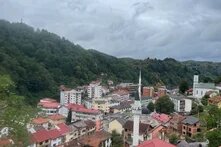
The SNS failed in its attempt to capitalise on the specific relations with Bosnia and Herzegovina, Kosovo and Russia, because the Student List oriented itself towards the social mainstream on all these issues. The brazen restrictions on out-of-country voting proved to be another own goal. The defiant reaction of the Serbian diaspora – some of whom travelled thousands of kilometres to cast their ballots, while in the USA, for example, they had to vote at night – had a mobilising effect back home. It drew international media attention to the reports of the ODIHR and CRTA election observation missions, according to which these elections were neither free nor fair.
In the referendum-like atmosphere generated by the SL ("Serbia or the Mafia"), the remaining opposition actors – such as the pro-EU European List and an anti-EU platform called Authentic Right – were unable to sharpen their programmatic profiles. All the more so because a number of smaller parties, such as the Green-Left Front (ZLF) and the liberal Free Citizens Movement (PSG), campaigned for the SL. In doing so, they knowingly accepted that they themselves would not enter parliament – a painful but highly responsible strategic decision, especially for parties whose own political roots and future are by no means secure, and which now lose state party funding.
The fourth phase – a leap into the unknown, with new possibilities
There was considerable doubt as to whether Vučić would accept the result.
That the SL would come out ahead could be surmised after the huge closing rally on 22 October. But there was considerable doubt as to whether Vučić, who had massive police forces assembled in Belgrade on election day, would accept the result. That he did so immediately sparked incredible euphoria on the streets. Soon, however, deep mistrust also set in, along with fear of further SNS manipulation that could block the peaceful transfer of power. Although the dynamic developments since then must be described elsewhere, the following concluding assessments are warranted from today's perspective.
Despite physical attacks on individual election observers, the support structure held firm and gathered extensive evidence of manipulation (e.g. vote-buying and photographing ballots, voting without valid documents, stuffing extra ballots, physical obstruction of the voting process). At the same time, the number of polling stations where the vote had to be repeated on 1 November due to irregularities was small: 53 (out of 8,392). This will not affect the final results or their certification.
The SNS system's sense of impunity dissolved almost overnight. Countless citizens immediately launched high-profile actions that amounted to a reclaiming of public space. They cleared and cleaned up the paramilitary camp in the city centre and painted over thousands of hate graffiti and regime slogans. Even before the formal handover of power, signs multiplied in the media and the prosecution service of a return to law-abiding conduct. There have already been several resignations at the public broadcaster, along with calls to revoke the licences of TV channels such as TV Informer. The Supreme Public Prosecutor's Office opened investigations into officials and police officers, and the first arrests followed.
The consequences for Serbia's political system will be immense. The new parliament will include only the SL (53 percent, 140 seats), the SNS (39 percent, 103 seats) and a few minority MPs. All other parties either failed to clear the threshold or did not run. Since the presidential election must be held by the end of the year, and the new government may bring local elections forward to push the SNS out of positions of power at the municipal level as well, it remains to be seen whether the parties that failed to clear the threshold can find a place for themselves.
The consequences for Serbia's political system will be immense.
On the basis of its parliamentary majority, the SL will form a government of fresh faces – people with social standing but no political experience whatsoever – and bring them into top positions. It is not apolitical; rather, it refers emphatically to the core demands of the student movement, which put the political as such at the centre: a state of the citizens and for the citizens, run by experts. Under the conditions of parliamentary democracy, a difficult budget situation and regional challenges, the SL must now prove that it can maintain constructive contact with a student movement that is once again transforming itself, and with the multitude of grassroots civic initiatives.
What was on the ballot was a European state with the rule of law and prosperity – not the EU with its many expectations of candidate countries. With the change of power in Belgrade, good-neighbourly relations and progress in European integration have once again become a possible future. The same applies to the delicate issues of memory politics, relations with Kosovo and the position of minorities. One can only hope that this hard, long-term work will benefit from the new social climate. What has been neglected in the 30 years since Srebrenica cannot be accomplished in 30 days. It will take courage, perseverance and the will to overcome the Serbian victimhood narrative deliberately fostered by the SNS, and to reach out to the neighbours.


