The United Arab Emirates has become a major investor in the Western Balkans. With enlargement back on the agenda, the EU must ensure that foreign capital meets rather than undermines its governance standards.
Over the past year, we have witnessed ever-increasing public interest in issues related to the environment and climate change. In spite of this, progress on Chapter 27 has, in many ways, remained in quarantine.
For the past three decades, Western Balkan countries have been going through a dynamic period of consolidation of new states, economic transition and transformation of social values. This process of regional and internal consolidation is unfinished and the legacy of conflict is still powerful; yet the outlook of EU accession is the one positive project offering a perspective to societies and economies while settling the wounds of the past.
In 2020, a number of international conferences and talks marking the 25th anniversary of the Dayton Accords brought the country back into the international spotlight. On this occasion, the Heinrich Böll Foundation's office in Sarajevo captured numerous voices on how to deal with the dysfunctional system.
Recent developments in Southeastern Europe are diminishing the image of the European Union and its perspective of the region. The long history of the dispute over the history of the region of Macedonia, the identity of ethnic Macedonians and the question of the Macedonian minority in Bulgaria is threatening the EU integration of North Macedonia, but also the entire Western Balkan 6.
Thus far, BiH political leaders have not demonstrated substantial progress in fulfilling the integration’s requirements, nor in joint efforts of prioritizing EU integration and putting it before particular ethnic interests. In case of Mr. Čović and the Croatian Democratic Union (HDZ BiH), it is necessary to keep in mind the type of EU-BiH perspective they advocate for, as well what their policies imply for BiH.
As the EU’s focus has shifted away from the region, the situation in the Western Balkans has deteriorated. In addition to Russia and China, the Western press has frequently highlighted Turkey being particularly interested in exerting its influence, which could potentially disrupt the EU’s approach in the region. But how much, in reality, is Turkey willing, ready and able to influence the countries of the Western Balkans? This paper will try to provide a summary of relevant issues regarding Turkey’s position in the Western Balkans as a baseline for discussion at the upcoming November 6th roundtable in Belgrade.
The “Strategy Group for a political, societal and economic European integration of the
Western Balkans Six” is a group of legal, historical and political researches from all WB6
countries organized by Heinrich Böll Stiftung’s Belgrade, Sarajevo and Berlin offices.
Its aim is to credibly advocate for a more effective European integration of the Balkans
in European as well as Balkan capitals.
It seems that the expected transition to democracy and free market economy in ‘western Balkans’ has become a never-ending story. Societies are weak, pluralism develops slowly and with great difficulties, political elites still dominate, and economies are still dependent either on political authorities or on international companies. At the same time, we bear witness to authoritarianism, intolerance, more or less constant popular support to the same political leaders or parties who get re-elected in spite of the poor economic and social performance of their respective governments, and the widespread corruption.
When a country is going through deep systemic changes in its political, economic, and ideological makeup, its (inter)dependence on the international environment may intensify greatly. This took place in almost all post-communist countries 25 years ago. The need to use internationally established models in systems which are only beginning to develop political pluralism and democracy, as well as solutions for functioning rule of law, and overall opening up of society, which is accompanied by the ideal of freedom, have led to a conscious openness to external influence.
The articles compiled for this edition of Perspectives bring together different accounts of current challenges for international intervention in Albania, Bosnia and Herzegovina, Croatia, Macedonia1, and Serbia.
1This edition of Perspectives was published before the Prespa Agreement
Analysis of EC Progress Reports on Serbia since 2012 to determine how the reports reflect on the ground reality and actual adherence to EU commitments and values.
Perspectives Southeastern Europe (SEE) is a publication series produced in cooperation between the SEE branches of the Heinrich-Böll-Stiftung. With this series, we aim to provide, primarily for the foreign readership, better insight into specific Southeastern European perspectives, as well as to analyze global societal and political trends reflected through the prism of our region. The focus of Perspectives SEE shall remain mainly on the countries in SEE where the Foundation has established its offices and/or where our activities are being carried out: Croatia, Bosnia and Herzegovina, Serbia, Kosovo, Montenegro, Albania and Macedonia.
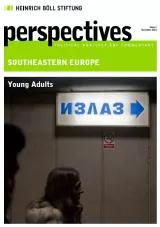
The first issue of Perspectives Southeastern Europe is dedicated to the specific status of young adults in the Balkans, given the fact that they are featured by a different form of transition to adulthood as compared to their Western European peers. Namely, the countries of Eastern and Southeastern Europe are characterized by a transition to adulthood that has been very much standardized in the tradition of communist government systems.
A hard copy of this issue you can order from our Belgrade office.
Although it increasingly perceives itself as an important pillar in international relations, Turkey’spolicy in the Western Balkans is in line with the NATO priorities of stability in the WesternBalkans.
Twenty years after the epoch-making change in 1989, which affected the post-Yugoslavian space in a way entirely different from other former “real-socialist” European countries, this study is an effort toward an analytical view on the past two decades of development of civil society in the western Balkans.
In the words of the Polish journalist and dissident, Adam Michnik, 1989 was Europe’s annus mirabilis. The peaceful revolution of that year was a miracle effected by the people in central and eastern Europe. Hardly any one (and certainly no western head of state or politician) had foreseen that a popular movement active in different countries would, in just a few months, topple socialist regimes and force the mighty Soviet Union to retreat behind the borders of Russia.